Saturday, June 6, 2020
Tuesday, May 12, 2020
Monday, May 11, 2020
Environment Action Programme to 2020
Over the past decades the European Union has put in place a broad range of environmental legislation. As a result, air, water and soil pollution has significantly been reduced. Chemicals legislation has been modernised and the use of many toxic or hazardous substances has been restricted. Today, EU citizens enjoy some of the best water quality in the world and over 18% of EU's territory has been designated as protected areas for nature.
However, many challenges persist and these must be tackled together in a structured way.
The 7th Environment Action Programme (EAP) will be guiding European environment policy until 2020. In order to give more long-term direction it sets out a vision beyond that, of where it wants the Union to be by 2050:
"In 2050, we live well, within the planet’s ecological limits. Our prosperity and healthy environment stem from an innovative, circular economy where nothing is wasted and where natural resources are managed sustainably, and biodiversity is protected, valued and restored in ways that enhance our society’s resilience. Our low-carbon growth has long been decoupled from resource use, setting the pace for a safe and sustainable global society."
It identifies three key objectives:
- to protect, conserve and enhance the Union’s natural capital
- to turn the Union into a resource-efficient, green, and competitive low-carbon economy
- to safeguard the Union's citizens from environment-related pressures and risks to health and wellbeing
Four so called "enablers" will help Europe deliver on these goals:
- better implementation of legislation
- better information by improving the knowledge base
- more and wiser investment for environment and climate policy
- full integration of environmental requirements and considerations into other policies
Two additional horizontal priority objectives complete the programme:
- to make the Union's cities more sustainable
- to help the Union address international environmental and climate challenges more effectively.
The programme entered into force in January 2014. It is now up to the EU institutions and the Member States to ensure it is implemented, and that priority objectives set out are met by 2020.
More Information:
Sunday, May 10, 2020
Friday, May 1, 2020
Saturday, April 25, 2020
Climate Change
The current warming trend is of particular significance because most of it is extremely likely (greater than 95 percent probability) to be the result of human activity since the mid-20th century and proceeding at a rate that is unprecedented over decades to millennia.
Earth-orbiting satellites and other technological advances have enabled scientists to see the big picture, collecting many different types of information about our planet and its climate on a global scale. This body of data, collected over many years, reveals the signals of a changing climate.
The heat-trapping nature of carbon dioxide and other gases was demonstrated in the mid-19th century. Their ability to affect the transfer of infrared energy through the atmosphere is the scientific basis of many instruments flown by NASA. There is no question that increased levels of greenhouse gases must cause the Earth to warm in response.
Ice cores drawn from Greenland, Antarctica, and tropical mountain glaciers show that the Earth’s climate responds to changes in greenhouse gas levels. Ancient evidence can also be found in tree rings, ocean sediments, coral reefs, and layers of sedimentary rocks. This ancient, or paleoclimate, evidence reveals that current warming is occurring roughly ten times faster than the average rate of ice-age-recovery warming.
The evidence for rapid climate change is compelling:
Global Temperature Rise
- The planet's average surface temperature has risen about 1.62 degrees Fahrenheit (0.9 degrees Celsius) since the late 19th century, a change driven largely by increased carbon dioxide and other human-made emissions into the atmosphere. Most of the warming occurred in the past 35 years, with the five warmest years on record taking place since 2010. Not only was 2016 the warmest year on record, but eight of the 12 months that make up the year — from January through September, with the exception of June — were the warmest on record for those respective months.
Warming Oceans
- The oceans have absorbed much of this increased heat, with the top 700 meters (about 2,300 feet) of ocean showing warming of more than 0.4 degrees Fahrenheit since 1969.
Shrinking Ice Sheets
- The Greenland and Antarctic ice sheets have decreased in mass. Data from NASA's Gravity Recovery and Climate Experiment show Greenland lost an average of 286 billion tons of ice per year between 1993 and 2016, while Antarctica lost about 127 billion tons of ice per year during the same time period. The rate of Antarctica ice mass loss has tripled in the last decade.Image: Flowing meltwater from the Greenland ice sheet.
Glacial Retreat
- Glaciers are retreating almost everywhere around the world — including in the Alps, Himalayas, Andes, Rockies, Alaska and Africa.Image: The disappearing snowcap of Mount Kilimanjaro, from space.
Decreased Snow Cover
- Satellite observations reveal that the amount of spring snow cover in the Northern Hemisphere has decreased over the past five decades and that the snow is melting earlier.
Sea Level Rise
- Global sea level rose about 8 inches in the last century. The rate in the last two decades, however, is nearly double that of the last century and is accelerating slightly every year.Image: Republic of Maldives: Vulnerable to sea level rise.
Declining Arctic Sea Ice
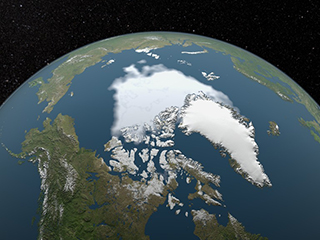
Both the extent and thickness of Arctic sea ice has declined rapidly over the last several decades.Image: Visualization of the 2012 Arctic sea ice minimum, the lowest on record.Extreme Events
- The number of record high temperature events in the United States has been increasing, while the number of record low temperature events has been decreasing, since 1950. The U.S. has also witnessed increasing numbers of intense rainfall events.
Ocean Acidification
- Since the beginning of the Industrial Revolution, the acidity of surface ocean waters has increased by about 30 percent.This increase is the result of humans emitting more carbon dioxide into the atmosphere and hence more being absorbed into the oceans. The amount of carbon dioxide absorbed by the upper layer of the oceans is increasing by about 2 billion tons per year. See Original Article: https://climate.nasa.gov/evidence/
Thursday, April 16, 2020
How Does Hunting Affect the Environment?
Updated April 25, 2018
By Kimberly Turtenwald
Hunting affects the environment in contrasting ways. People hunted three species of camel, woolly mammoths and giant armadillos into extinction in North America more than 12,000 years ago -- and that was when hunting was not a sport but a means of survival. Nowadays, most people hunt for sport, often leaving the carcass and taking the head, leaving the remains to decompose.
TL;DR (Too Long; Didn't Read)
In 2011 in the U.S. alone, 13.7 million people hunted animals as a sport. The U.S. Fish and Wildlife Service reports in its 2011 National Survey of Fishing, Hunting, and Wildlife-Associated Recreation that of that number, 11.6 million people hunted big game, 4.5 million hunted small game, 2.6 million hunted migratory birds, and 2.2 million hunted other animals.
Population Control
Across the United States, each state licenses and regulates hunting. Many states allow hunting of specific animals, such as deer, turkey and ducks, but place restrictions on hunters. States set restrictions and limits based on the season, the animal, its population numbers and U.S. Fish and Wildlife status. Depending on the animal, some states also place restrictions on which sex and how many animals a hunter can kill. All of these restrictions help keep populations from dropping too low. In scenarios where natural predators don't exist, if hunting was not allowed, some animals might overpopulate a region.
Environmental Imbalance
Because hunters are only allowed to pursue specific species, some environmentalists argue that hunting creates an imbalance in the natural elements of the environment. If a predator, like wolves or mountain lions, are hunted to lower numbers, their prey often increase in number. Nature has a delicate balance and human hunting can have an impact on that natural balance. Opponents to hunting claim that animals have their own ways of population control and humans are not needed to aid that process.
Hunted to Extinction
The University of Michigan predicts over hunting will be the cause of extinction in about 25 percent of all animal extinctions during the 21st century. Whales and some African animals have become endangered due to hunting issues. Even with hunting restrictions in place, poaching, which is illegal hunting, is still an issue. In less populated areas, it can be difficult to catch and punish those who are over hunting a particular species.
Environmental Contribution
Hunters may take animals out of the environment, which could have a negative impact on the environment, but they also often contribute to the environment in a positive manner. The fees collected by the individual states for hunting licenses, park permits and other fees are often used to improve the environment. Some hunters also contribute on their own to environmental organizations that conserve and preserve wildlife and natural areas.
When we protect nature, nature protects us
In early 2019, The United Nations General Assembly declared 2021–2030 the UN Decade on Ecosystem Restoration.
Convened by the UN Environment Programme (UNEP) and the Food and Agriculture Organization of the United Nations, the plan is to remove up to 26 gigatons of greenhouse gases from the atmosphere by bringing at least 350 million hectares of degraded landscapes under active restoration by 2030.
So it was with optimism that a September Global Landscape Forum meeting in New York began with Germany’s Director General for Nature Conservation and Sustainable Use of Natural Resources and Environment, Nature Conservation and Nuclear Safety at the German Ministry (BMU), Christiane Paulus, announcing financial support for the decade’s activities.
Next, UNEP Executive Director Inger Andersen praised the “phenomenal leadership” that Germany has shown in committing to the decade, and warned that change must be galvanized for action among all for restoration.
“It is so very clear we need to shift our ways and change our interaction with nature,” she said. “In this room you have energy, commitment, solutions. We can do this. Let’s just do this,” she said.
She noted the importance of both conservation of remaining forests and other natural habitat, and the need for restoration: “two hands clapping, both are critical” to take the restoration agenda forward, she said.
“Nature is our greatest ally. Nature is under threat,” she said. Already, 3.2 billion people are affected by land degradation. Every year, 10 per cent of Gross Domestic Product is lost soil erosion, pollution and biodiversity loss, mostly caused by unsustainable agriculture.
There is a human, environmental and economic cost to land degradation, she said, yet nature is also the solution.
“Fasten your seatbelts,” she said. “We hold in our hands this frightening responsibility, this awesome responsibility, to forever change the very trajectory of our planet.”
Planting trees and decarbonizing go together, and action is needed within every sector to green cities and bring down temperatures. “Because when we protect nature, nature protects us,” she said.
Scientists say that restoring the world’s forests by planting a trillion trees is by far the most promising--and cost-effective--means of tackling climate change. But this has to be done right, with the right trees and the right place and time.
Beyond sequestering carbon, these trees can guard against extreme weather events; protect endangered species; and bring shelter, food, money and cultural preservation to communities around the world.
Yet ecosystems also include wetlands; the Arctic peatlands, which make up some 30 percent of the Earth’s land surface and store 8 percent of all below-ground carbon, as well as the oceans, mountains and drylands.
Restoration includes creating green jobs
“The decade on restoration must include co-benefits for the Sustainable Development Goals that go way beyond climate change,” said Tim Christophersen, head of UNEP’s Freshwater, Land and Climate Branch and focal point to prepare the UN Decade.
Restoration includes creating green jobs, helping restore biodiversity, helping farmers make better incomes, stabilizing water supply for big cities, and stabilizing food supplies, he said.
“The UNEP Executive Director has made it clear that US$800 billion to restore 350 million hectares sounds like a lot of money, but it really isn’t,” he added, speaking at the Global Landscape Forum.
“It’s two years’ worth of fossil fuel subsidies. So, we have to help countries to redirect public money into this and encourage more private money to flow in the same direction, towards nature and towards restoration.”
“The same could be said for agricultural subsidies. The world spends about 1 million dollars per minute on agricultural subsidies that are often driving biodiversity loss and driving climate change. We can re-programme those subsidies to regenerate agriculture and restoration.
“There is amazing new technology which helps large funds to help small farmers, through blockchain for example. So, we have the architecture now to enable even smallholder farmers to access capital, but all kinds of investments are still needed. The unique power of the UN is to convene, give very clear policy guidance, encourage market signals and the shifting of fiscal policies.”
Philippe Zaouati, Chief Executive Officer of Mirova, an investment banking firm which helps companies target global investment to minimize risk with increased responsibility, said:
“We need to look at the macro and micro level. We used to look at big investments and corporates. In the face of new economic models which have not yet reached the level of maturity… we need public players, private sector to work together.
“Today, the bulk of money is still going to traditional investments,” he added. “We have to create new indices, new benchmarks and new targets, and invest in the world that want to see in the coming decades.”
Others pointed to massive efforts and action on solutions already under way. Susan Chomba, a social scientist at the World Agroforestry Centre, said research is needed to provide policymakers with “hard evidence” on restoration potential.
“It’s not just about tree planting, but restoration includes livestock management… to restore degraded land. Land restoration is about people… we can capture their livelihood needs and aspirations… bringing women to the table--or under a tree.”
Stephen Fern, Chairman of the Board of G9 Ark, spoke of the Grand African Savannah green-up programme, a US$85 million project to support two million households to restore two million hectares over the next 5 years – the biggest grassroot restoration project in sub-Saharan Africa.
“Greta [Thunberg] asked my generation to act like the house is on fire,” he said. “Well the fire brigade is here,” he said.
Monday, March 16, 2020
Subscribe to:
Posts (Atom)